

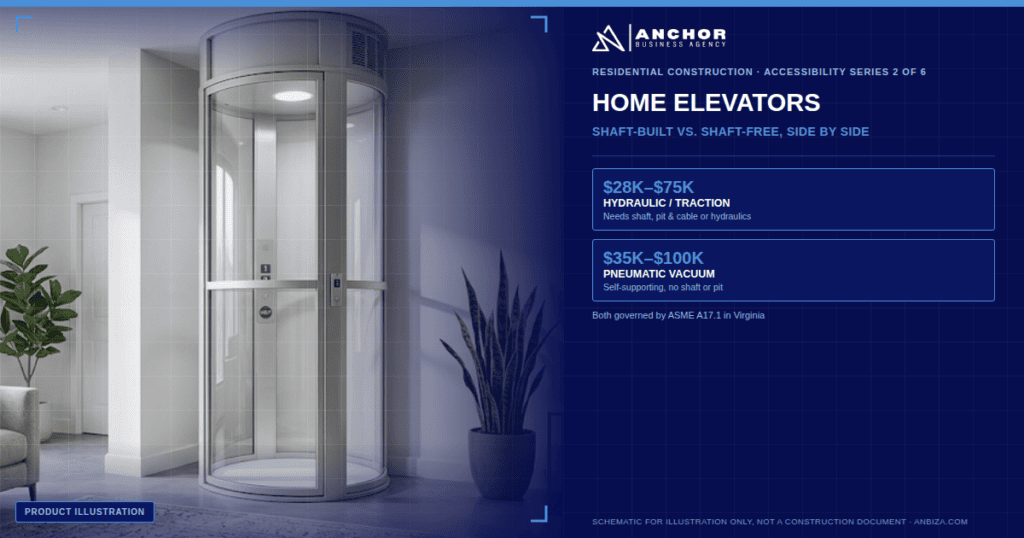
A residential elevator is not a plug-and-play mobility product. It is a structural addition that needs a shaft or a self-supporting cab, an electrical circuit, a permit, and in most Virginia jurisdictions, plan review against the same code that governs commercial elevators. Here is what the different types cost and what the permitting process actually looks like.
The Main Types
Vertical platform lifts (VPLs) move straight up and down over a short rise and are typically used for porches, decks, or split-level entries. Inclined platform lifts run diagonally along an existing staircase and fold against the wall when not in use. Full home elevators come in several drive systems: hydraulic, cable-driven traction (including gearless traction, which handles higher capacity), and pneumatic or vacuum elevators, which are self-supporting and do not require a shaft or pit, cutting retrofit time to a few days instead of several weeks.
What It Costs
According to HomeGuide’s 2026 cost data, the national average for a home elevator is $48,000, with a typical range of $30,000 to $60,000 for a two-story installation. By drive system: hydraulic runs $30,000 to $60,000, winding drum/cable-driven runs $28,000 to $50,000, geared traction runs $30,000 to $60,000, gearless traction runs $50,000 to $75,000, and pneumatic vacuum elevators run $35,000 to $100,000 depending on size and finish. Each additional floor served adds roughly $10,000 to $15,000 to the total.
Virginia Code and Permitting
Residential elevators in Virginia fall under the Virginia Construction Code, which incorporates ASME A17.1, the national safety code for elevators. Platform lifts and stairway chairlifts are governed by a separate standard, ASME A18.1. Contractors performing this work generally need the Accessibility Services Contracting (ASC) or Elevator/Escalator Contracting (EEC) specialty designation on their Virginia contractor license.
Review timelines vary by jurisdiction. Fairfax County offers a standard review that typically takes 14 days, or a fast track review of 48 to 72 hours for applications that meet expedited processing requirements, according to the county’s Land Development Services elevator permit page. Every jurisdiction has its own submission requirements, so the timeline should be confirmed with the local building department before a project is scheduled.
Why This Matters for Your Project
An elevator installer that only sells and installs the equipment is not necessarily positioned to handle the structural framing, the electrical rough-in, or the permit submission that a shaft-built or even a shaft-free elevator still requires under Virginia’s code. As a licensed general contractor, we handle the structural and electrical work, the permitting, and the coordination with the elevator manufacturer’s install team, so the equipment goes into a space that was actually built and permitted for it.
A home elevator means every floor of your house stays yours to enjoy, for as long as you want to live there. Call (703) 594-0332 or request a consultation, and we will get it designed, permitted, and built right the first time.