

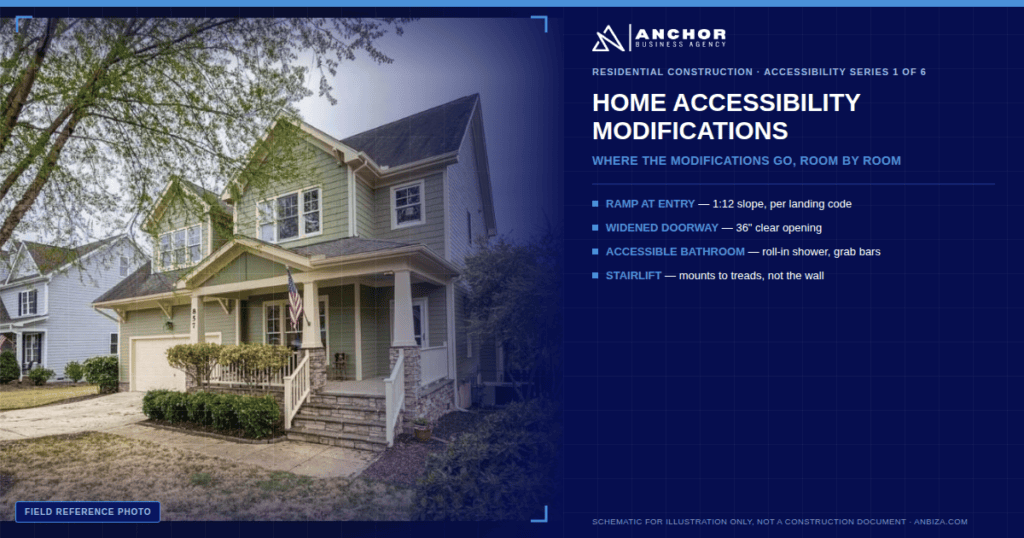
Most homeowners researching accessibility modifications start with a single question: what does a ramp cost, or what does a walk-in shower cost. That question gets answered by a dozen different vendors, each selling one piece of the project, with nobody looking at how the ramp, the bathroom, the doorways, and the stairs are supposed to work together as the resident’s mobility changes over time.
Anchor Business Agency (ANBIZA) is a licensed general contractor, not a single-product installer, so we look at accessibility projects as a sequence, not a shopping list. Here is what the data says about who needs these modifications, and where the sequence typically starts.
Most Homes Are Not Built for This
About one in four American adults, more than 70 million people, live with a disability, according to CDC data. Fewer than 4 percent of U.S. homes have the three basic features that make independent living possible: a no-step entrance, single-floor living, and a wheelchair-usable bathroom.
The demand is already here. In AARP’s 2024 Home and Community Preferences Survey, 75 percent of adults 50 and older said they want to remain in their current home as they age, and 73 percent want to stay in their community. Forty-three percent expect to need home modifications to make that possible. Of that group, 72 percent expect bathroom changes like grab bars and no-slip surfaces, and 71 percent expect changes that improve mobility around the home, such as ramps or chairlifts.
There is a real cost to not making these changes. The CDC reports that more than one in four older adults falls each year, about 37 percent of those falls cause an injury serious enough to require medical care, and nearly 319,000 older adults are hospitalized annually for hip fractures from falls. The average inpatient stay for a fall-related injury costs $18,658.
Where the Sequence Usually Starts: The Bathroom
The bathroom is the room used daily and the room where falls are most likely, which is why it is typically the first project. A full accessible bathroom remodel, grab bars, a curbless or roll-in shower, a comfort-height toilet, and non-slip flooring, runs $5,600 to $12,000, averaging around $8,400, according to Angi’s 2026 cost data. Grab bars alone can be added for a few hundred dollars as an interim step.
Getting In and Moving Through the Home
After the bathroom, most projects move to entry and circulation. A wheelchair ramp runs $100 to $250 per linear foot depending on material (wood, aluminum, or concrete), which puts a typical 24-foot ramp in the $4,200 to $5,400 range installed, per HomeGuide’s 2026 data. Doorway widening for wheelchair clearance runs $50 to $3,000 depending on target width, with a 36-inch clear opening (the ADA-recommended comfortable width, versus the 32-inch minimum) typically running $600 to $2,500, per Angi.
Whole-Home Mobility: Ramps, Lifts, and Elevators
For homes with stairs between living levels, the next step is usually a stairlift or, for a full-time wheelchair user or someone planning to age in place long-term, a home elevator or vertical platform lift. We cover both of those in dedicated posts, since the products, costs, and permitting requirements are different enough to need their own explanation.
Why a General Contractor Should Be Planning This, Not Just Installing It
A ramp company installs ramps. A shower company installs showers. Neither one is thinking about how the bathroom renovation affects the doorway width you will need later, or whether the ramp’s landing will still make sense once the entry gets reworked. As a licensed Virginia Class A general contractor, we plan the sequence, pull the permits, and coordinate the trades, so the bathroom work done this year does not have to be redone when the entry work happens next year.
Some of these projects are eligible for VA benefit funding (HISA, SAH, and SHA grants) or Virginia’s Livable Home Tax Credit, which we cover in a separate post since the eligibility rules are detailed enough to deserve their own explanation.
Staying independent in the home you love is worth building toward. Call (703) 594-0332 or request a consultation, and we will map out the right sequence so your home keeps working for you, for years to come.