

Most information available about VA’s home modification grants comes from either the VA itself, written for eligibility purposes, or from equipment-sales companies, written to sell a ramp or a lift. Very little of it addresses what happens on the construction and permitting side once a grant is approved, which is where we can speak directly, as a licensed Virginia general contractor.
Here are the three main programs, their current amounts, and what they actually cover.
HISA: Home Improvements and Structural Alterations
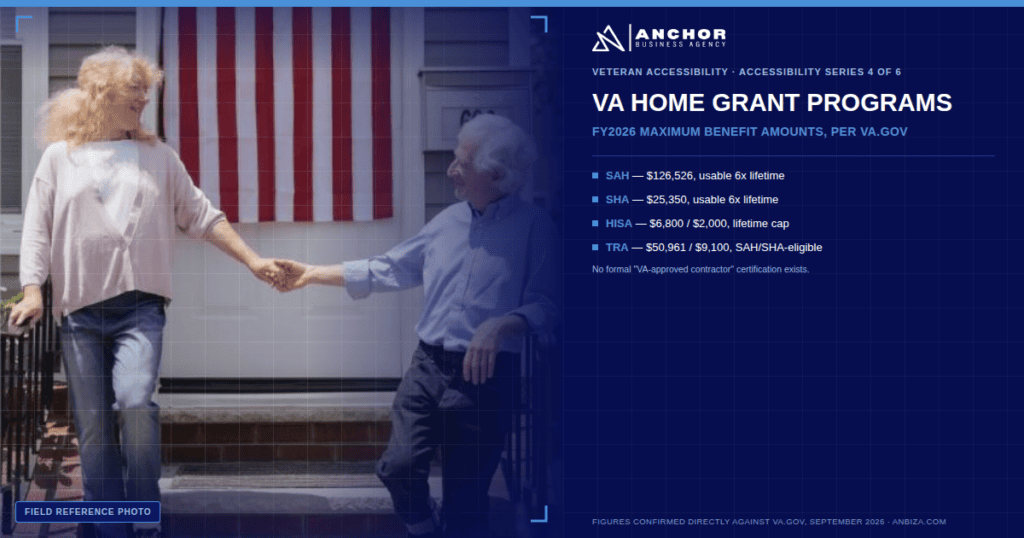
HISA is the most accessible of the three programs administratively, since it does not require a Regional Loan Center application. The lifetime maximum is $6,800 for veterans with a service-connected disability (or a disability treated “as if” service-connected through VA vocational rehabilitation, or a non-service-connected condition alongside a separate 50 percent or higher service-connected rating). Veterans without that rating qualify for up to $2,000.
HISA covers medically necessary modifications: entryway and exit accessibility, roll-in showers, kitchen and bathroom fixture adjustments, permanent ramps, and plumbing or electrical work tied to medical equipment. It explicitly excludes exterior decking, hot tubs or spas, walkways to detached structures, stairlifts, portable ramps, new construction, and routine maintenance like roof or HVAC replacement, according to VA’s Prosthetic and Sensory Aids Service. Every HISA project requires a physician’s prescription documenting medical necessity. Applications go through the local VA medical center’s Prosthetic and Sensory Aids Service using VA Form 10-0103.
SAH: Specially Adapted Housing
SAH is a substantially larger benefit intended for veterans with more severe mobility-related service-connected disabilities. The FY2026 maximum is $126,526, confirmed directly on VA.gov’s disability housing grants page. It can be used to build, buy, or adapt a home to be wheelchair-accessible, and it can be used up to six times over a veteran’s lifetime, with the VA adjusting the maximum annually.
SHA: Special Housing Adaptation
SHA serves a different set of qualifying conditions, generally upper-body disabilities, certain vision loss, and severe burn injuries, at a lower funding level. The FY2026 maximum is $25,350. Like SAH, it can be used up to six times over a veteran’s lifetime.
TRA: Temporary Residence Adaptation
For SAH- or SHA-eligible veterans living temporarily in a family member’s home rather than their own, TRA provides up to $50,961 (SAH-eligible) or $9,100 (SHA-eligible) to adapt that residence.
SAH and SHA applications go through a VA Regional Loan Center using VA Form 26-4555.
What “VA-Approved Contractor” Actually Means, and What It Doesn’t
There is no formal “VA-approved contractor” or “VA-certified contractor” credential for accessibility or home modification work. The only related VA registration is a one-time Builder ID number, required for contractors performing SAH/SHA new-construction or major-adaptation projects, which VA’s own SAH builder training materials describe as a one-time registry, not a certification that must be renewed or maintained. It is a registration requirement, not an endorsement of quality. Any contractor claiming to be “VA-approved” or “VA-certified” for this kind of work should be asked exactly what that claim refers to.
What we can accurately say about our own work: we help veterans navigate the paperwork and construction sequencing for HISA, SAH, and SHA-funded projects, and we build to the standard those programs require.
Stacking With Virginia’s Livable Home Tax Credit
Virginia veterans doing accessibility work do not have to choose only federal funding. The state’s Livable Home Tax Credit (LHTC), administered by the Virginia Department of Housing and Community Development, offers up to $6,500 for new construction of an accessible home, or up to 50 percent of renovation costs (maximum $6,500) for retrofitting an existing home. It is a state income tax credit, separate from and stackable with VA grant funding, and it is available to any Virginia homeowner, not just veterans. Combining HISA or SAH/SHA funding with the LHTC can meaningfully offset a project’s total cost.
You earned this benefit. Put it to work. Call (703) 594-0332 or request a consultation, and we will help you turn your HISA, SAH, SHA, or LHTC funding into a home that works for you.