

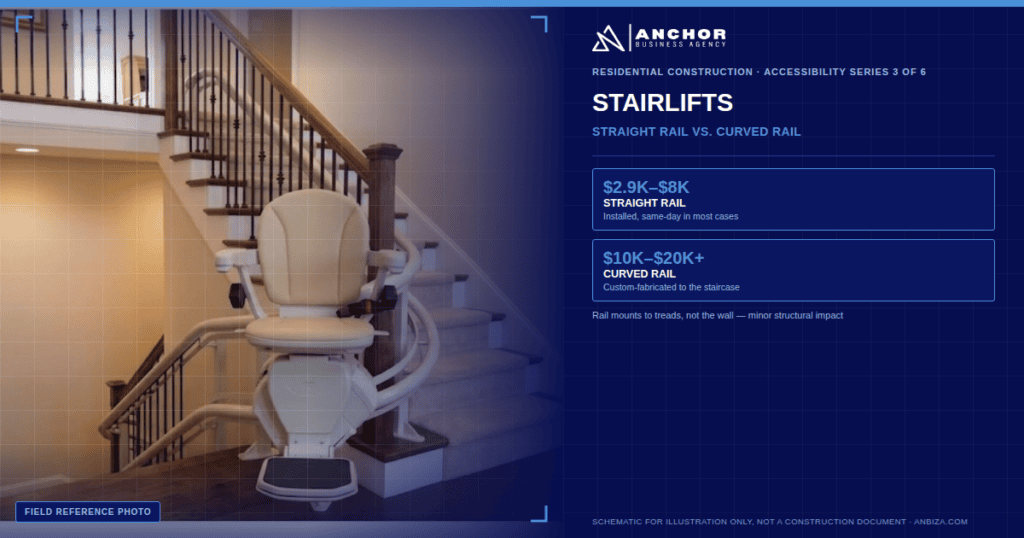
Of the major accessibility products, a stairlift is usually the fastest to install and the easiest to remove later if it’s no longer needed. It is also one of the most misunderstood when it comes to VA benefit funding, so we will cover both in this post.
Types and What They Cost
Straight rail stairlifts are the most common and least expensive option, since the rail comes pre-manufactured and is trimmed to fit a standard staircase. Curved rail stairlifts are custom-fabricated for staircases with landings, turns, or spiral sections, which is why they cost significantly more. Outdoor stairlifts use weatherproofed components with a cover. Perch or standing stairlifts serve people who cannot fully bend their knees or hips, such as after certain surgeries.
Based on regional pricing from Bedco Mobility, which serves Maryland, DC, and Virginia, new straight stairlifts run $3,500 to $6,500 installed, new curved stairlifts run $10,000 to $20,000 or more, outdoor units run $4,500 to $7,500, and used or reconditioned units run $2,000 to $5,000. Monthly rentals, useful for a temporary need like post-surgery recovery, run $150 to $350 per month. Lifeway Mobility, which also serves the Northern Virginia and DC area, quotes a similar range of $2,900 to $8,000 for straight units and $12,000 and up for curved units.
Installation Is Less Invasive Than Most People Expect
A straight stairlift rail bolts into the treads of the staircase, not the wall, and does not touch load-bearing structure. A straight installation is typically a same-day job. Curved units take longer because the rail has to be custom-fabricated to match the exact staircase before it can be installed.
Why This Matters: The CDC’s Fall Data
More than one in four older adults falls each year, and nearly 319,000 are hospitalized annually for hip fractures from falls, according to the CDC. A stairlift removes the single highest-risk transition point in most two-story homes: the stairs themselves.
What VA Benefits Do and Don’t Cover
This is the part most other sources get wrong or leave out. The VA’s Home Improvements and Structural Alterations (HISA) grant explicitly excludes stairlifts by name, listed among the same excluded category as portable ramps and exterior decking, according to the VA Prosthetic and Sensory Aids Service’s own HISA guidance. If a stairlift is part of your accessibility plan, it generally cannot be paid for through HISA on its own.
The Specially Adapted Housing (SAH) and Special Housing Adaptation (SHA) grants are structured differently and may be able to include a stairlift as part of a larger, medically justified home adaptation plan, but this is not spelled out as a standalone covered item on VA’s own program pages. If you are a veteran considering VA benefit funding for a stairlift, the right move is to raise it directly with your VA caseworker or the Regional Loan Center handling your SAH/SHA application before assuming it is covered, since coverage depends on how your specific adaptation plan is structured.
A stairlift means the stairs stop being a limit and go back to just being stairs. Call (703) 594-0332 or request a consultation, and we will have it measured, ordered, and installed, often within days.